
As AI continues to reshape industries, organizations worldwide are facing an inevitable reality—culture change is no longer optional. They must adopt and leverage these new capabilities or suffer at the hands of those that do.
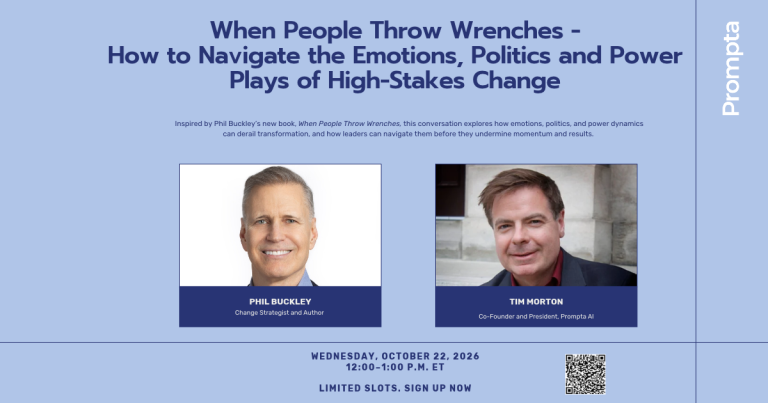
The introduction of AI in the workplace is not just about automation; it’s about transformation. Leaders must navigate the delicate balance between technological advancements and human adaptability, ensuring AI becomes an enabler rather than a disruptor. In a recent discussion hosted by Tim Morton of Prompta AI, Phil Buckley, a renowned change management strategist and author, shared illuminating insights on how AI can shape culture change. His message was clear: AI is an enabler, not a replacement for leadership and human engagement.
“AI is an enabler. It’s a tool. It’s a productivity tool. It’s an efficiency tool. It’s a decision-making tool to help you do better in some of the tasks that we typically would do.” – Phil Buckley
So, how can leaders effectively integrate AI into culture change while avoiding common pitfalls? Here are some key takeaways from the conversation.
1. AI Doesn’t Change Culture—People Do
One of the biggest misconceptions is that AI alone will drive cultural transformation. But culture is built through people—their behaviors, beliefs, and interactions. AI can provide insights and streamline processes, but it cannot replace the human element that makes a culture thrive.
“Cultures are defined through the people, the work they do, how they think, and how they behave—led by their leaders. AI is simply an enabler to develop the culture you’re striving for.” – Phil Buckley
Leaders must co-create cultural change with their teams, ensuring AI supports, rather than dictates, the transformation.
2. Overcoming Fear and Resistance with AI-Driven Insights
Resistance to change is a natural human response, and AI implementations often trigger fear of job displacement or loss of autonomy. The media fuels this anxiety with sensational
headlines about robots taking over the workforce. But as Buckley emphasized, AI should be seen as a competitive advantage rather than a threat.
“If AI isn’t implemented well, the best intentions turn into the best forms of resistance.” – Phil Buckley
Rather than dismissing these concerns, organizations must use AI to provide transparency and real-time insights into employee sentiment. AI-powered analytics can help identify patterns of resistance early, allowing leaders to address concerns proactively.
3. The Power of Data-Driven Decision Making
Traditionally, culture change efforts relied heavily on manually aggregated qualitative feedback—employee pulse surveys, interviews, and leadership discussions. While valuable, this method often provided limited, insights of organizational sentiment.
AI revolutionizes this process by analyzing large datasets in real-time, uncovering hidden trends, sentiments, and engagement patterns across different demographics.
“With large datasets, AI enables organizations to detect sentiment, measure cultural shifts, and pinpoint areas that require intervention—things we might have previously missed.” – Phil Buckley
For example, AI helped uncover a toxic workplace culture in a specific location of a multinational company, despite leadership believing everything was running smoothly. By using AI-generated insights, leaders were able to take targeted actions to rebuild trust and engagement.
4. AI as a Tool for Breaking Down Silos
Siloed workplaces are one of the biggest barriers to culture change. Departments often operate in isolation, leading to miscommunication and misaligned goals. AI has the potential to break down these barriers by integrating data across functions, providing a holistic view of the organization.
“AI can analyze cross-functional data, revealing patterns that help organizations understand and form causal connections for where culture is thriving—and where it’s breaking down.” – Phil Buckley
By leveraging AI-driven insights, leaders can identify knowledge gaps, unify disconnected teams, and foster greater collaboration across the enterprise.
5. Customizing Change Strategies Through AI
One-size-fits-all traditional change management approaches no longer work. AI allows for segmentation of employee experiences, ensuring change initiatives are tailored to different groups within the organization.
“One size doesn’t fit all for change—especially not in culture change. AI helps identify natural clusters of people and determine the specific support they need.” – Phil Buckley
For instance, a senior leader may need a different change strategy than a frontline worker, and a new hire may require different engagement tactics than a tenured employee. AI enables hyper-personalized change plans that increase adoption and minimize resistance.
6. Leaders Must Go First
No AI-driven change initiative will succeed without visible leadership support. Leaders must model the behaviors they expect from their teams, demonstrating trust in AI and a commitment to transparency and continuous learning.
“If leaders aren’t actively engaged, the transformation won’t stick. It will just be another ‘flavor of the month’ initiative that fades away.” – Phil Buckley
Leaders must:
– Clearly communicate the why behind AI-driven culture change
– Champion AI use by supporting data-based insights and decisions
– Address fears and promote AI as an enabler rather than a replacement
Final Thoughts: AI and Human Intelligence Must Work Together
AI cannot replace human intuition, experience, and leadership. The most successful culture transformations will be those that leverage AI-driven insights alongside institutional knowledge.
“AI can surface insights, but it’s up to people—leaders and employees—to turn those insights into action.” – Phil Buckley
Organizations that embrace AI as a strategic enabler for culture change will not only adapt faster but gain a lasting competitive advantage. The question is no longer whether AI should be part of cultural transformation, but rather:
👉 How will you use AI to shape the future of your organization’s culture?